Estimated duration
3 h
Organizer
Taideyliopiston Sibelius-Akatemia
Public examination of the doctoral degree of Johanna Lehtinen-Schnabel
- Complete title of the dissertation: Beyond Disciplinary Boundaries: Language-Aware Choirs Driving Transformative Change in Music Education
- Responsible supervisor: Heidi Westerlund, University of the Arts Helsinki
Opponent: Professor Raymond MacDonald, University of Edinburgh
Programme
Opening of the public examination
Lectio praecursoria
Statement of the Opponent
Examination of the dissertation
Closing statement of the Opponent
Audience questions
Closing of the public examination
Abstract
This article-based doctoral dissertation aims to contribute to reconsidering established musical practice and forms of music education in the face of the interconnected challenges of contemporary societies, and to promote new, reconfigured practices that address wider societal challenges. The objective of the practitioner inquiry isto generate new understanding of transdisciplinary and systems-aware approach in music education through an intercultural, multilingual choir practice that integrates music and second-language learning, acknowledging the direct social needs and wishes of the participants who have migrated to Finland as adults. This dissertation asks: How can second-language (Finnish) learning be supported within a multilingual choir practice? What new insights can a language-aware choir generate for music educational thinking and actions?
Methodologically, the explorative research is grounded in activity theory and the idea of activity systems, being further informed by the theorisation of systems praxis, which together enable the linking of individual actions and broader social structures, as well as the communication of social changes. Multimethod and mixed-methods approaches are used to explore the phenomenon from diverse angles. The research materials comprise 24 semi-structured pre-, middle- and post-interviews with 11 choir participants and a second-language teacher, 57 Phonology pre- and post-tests, a researcher’s journal, field notes and material, and 18 videos of choir rehearsals, one concert, and a virtual choir performance. The findings have been reported in four peer-reviewed international articles, each based on a distinct sub-study and sub-questions.
The findings demonstrate that a language-aware approach in a choir has multiple potentials to support second-language learning, but requires music educators to move beyond professional boundaries. They show how a double meaning when integrating two distinct activity systems – language learning and meaningful musical experiences in a choir – can improve phonological processing and the production of spoken language in various ways, as well as encourage overall language use in new social contexts, while simultaneously fostering positive transformations in cultural, social, and societal participation and active citizenship in everyday life. The analysis illustrates how transdisciplinarity disrupts habitual actions and established principles of both musical practices and language learning, reconstructing the historical idea of art for art’s sake as well as the dominant notions of praxis in music education. The research contributes to the expanding understanding of music professionalism by arguing for sustainability-linked transdisciplinary transitions and systems awareness for professional practice to better respond to the new needs of society.
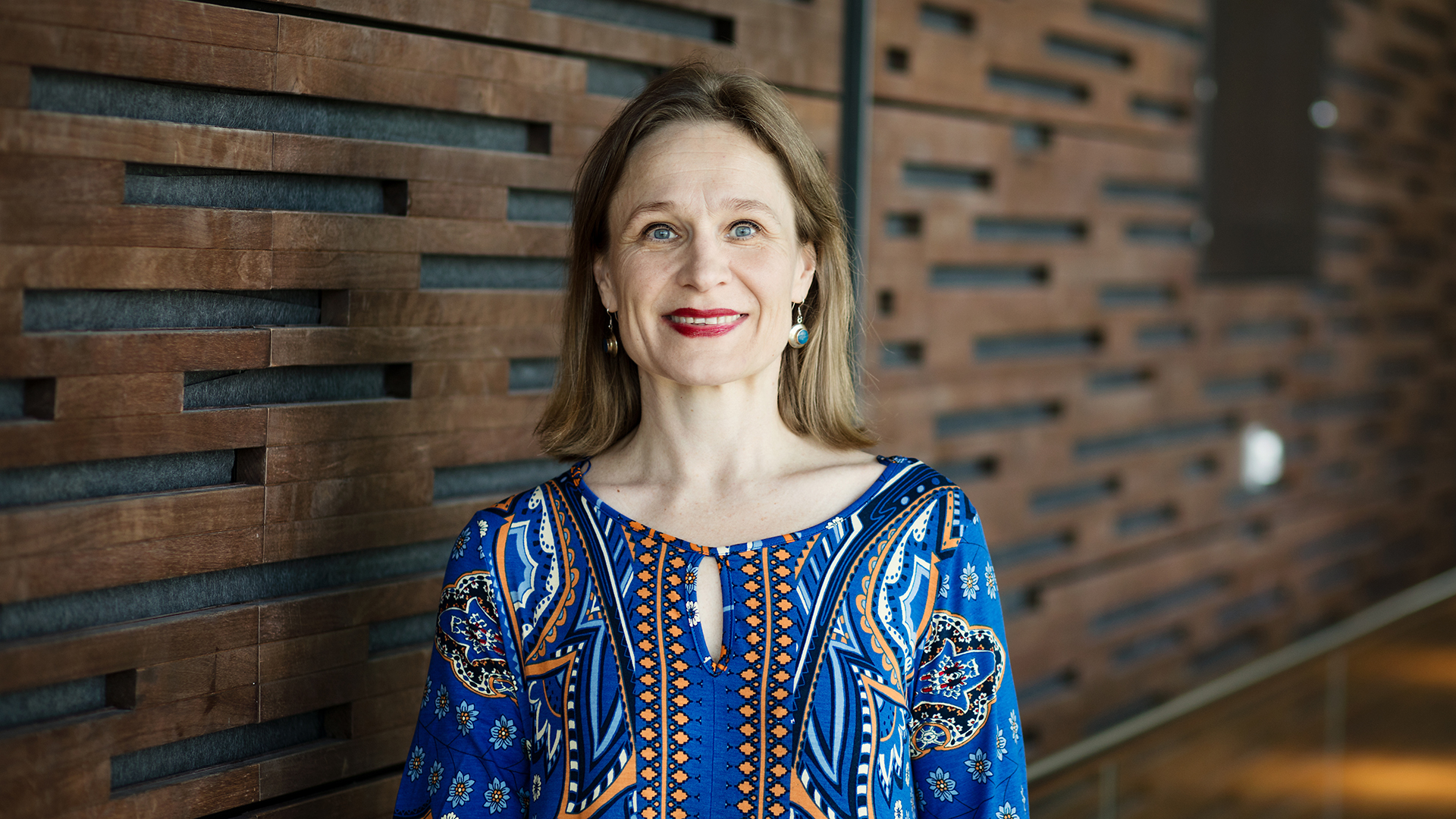
Johanna Lehtinen-Schnabel
Johanna Lehtinen-Schnabel is a doctoral researcher at the Sibelius Academy of the University of the Arts Helsinki, holding a master’s degree in music education (Sibelius Academy). As a choir conductor and music teacher, she has extensive experience across various fields of music education, including more than 20 years as a leading music teacher (Head of the Music Education) at the second largest Adult Education Centre in Finland (Espoo Adult Education Centre). In the field of Adult Education in Finland, she has been twice awarded as a Teacher of the Year (2004, 2014).
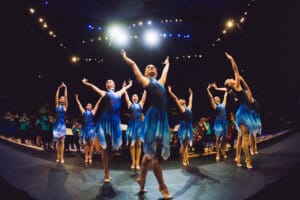
In her professional work, she has consistently been interested in developing novel pedagogical approaches and practices that could acknowledge diverse voices and broaden opportunities for participation, including for those who might otherwise be excluded from established music education systems. Over the years, she has also founded and conducted dozens of choirs and vocal groups from children’s to senior choirs, from professional singers to those who believe they can’t sing. In recent years, her focus has been on multilingual and intercultural choirs, which she also explores in her doctoral research project.
At the Sibelius Academy of the University of the Arts, Lehtinen-Schnabel has worked as a part-time lecturer since 2005; as a supervisor for music education student teachers, as a doctoral associate at the Doctoral School of Music education, Jazz and Folk Music, and as supervisor and lecturer in the pedagogical studies programme for international and national students. Based on her research, she was asked to develop – in collaboration with Finnish as a second language (L2) lecturer and the language team of the University of the Arts – Learn-Finnish-by-Singing courses for international students and staff (Sibelius Academy, Theatre Academy and Fine Arts Academy). Since 2023 these novel arts-integrated L2 courses have also been extended to include students and staff at the University of Helsinki and Aalto University. Related to her research project, Lehtinen-Schnabel has also given courses and supervised master students at the Metropolia University of Applied Sciences since 2024 (Creativity and arts in social and health fields master’s programme). Moreover, she regularly conducts Learn-Finnish-by-Singing workshops for all age groups and educational levels, from children to adult groups with their second language teachers, as part of cultural services in the Helsinki metropolitan area. In connection with her doctoral research project and music educational practice, she has gained considerable public recognition and visibility across both traditional and new media.
Lehtinen-Schnabel was the member of an interdisciplinary research project ELLA (2021-2024), funded by Kone foundation and coordinated by the University of the Arts Helsinki, that investigated how embodied language learning through the arts may generate substantial change within communities. To finalise her research project, she also got personal grants from the Alfred Kordelin Foundation and the Finnish Cultural Foundation.
More information
Johanna Lehtinen-Schnabel
johanna.lehtinen-schnabel@uniarts.fi
Tickets to Musiikkitalo concerts and other events are available to purchase on our website, by telephone and at our physical box office.
Book tickets for 10–20 or more people is by contacting group sales service by email at ryhmat@musiikkitalo.fi or by telephone on 0600 411 101 (Monday to Friday, 9:00–15:00).
How about a cup of coffee, a bite to eat or a glass of bubbly during the interval? Order your drinks in advance to beat the queues and make the most of your concert visit. Interval refreshments are not available at all concerts.
Our location could not be more central or easier to get to. Almost all forms of Helsinki public transport stop right outside our doors, cycle parking is provided at all our entrances, and Aimo Park Finlandia, our nearest multi-storey car park, offers lift access directly to our main foyer.
At Helsinki Music Centre we are proud to be an accessible and welcoming place for everyone. Tactile handrails and signage have been fitted across the building, and there are tactile indicator strips on the floor too to guide partially sighted and blind visitors. Induction loops are always available, and guide or companion dogs are of course permitted within the building.
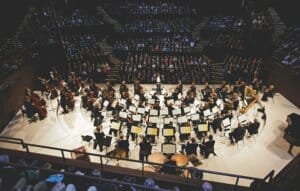
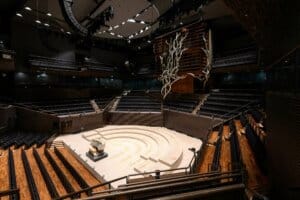
Concert Hall
When purchasing a concert ticket in the Music Centre’s ticket shop, you can view the sightline from your seat in a 360-degree view.
How to use the 360-degree view: Select your preferred seat on the seating map and then choose the ticket type.
On a mobile device, the 360-degree image opens when you tap the chevron at the top edge of the bottom panel. Tapping the image again opens it in full-screen mode, allowing you to rotate the view.
On a computer, you will find the “My Seat” section in the upper-right corner of the ticket shop. Below the heading, a photo of the Concert Hall is displayed. Clicking the image opens the view from the selected seat. You can rotate the image with your mouse to explore the view from the seat in greater detail.
The route to your seat is always printed on your ticket. Check the door number to find out which entrance to take. The seating areas are marked with letters. There is level access to all wheelchair seats from the main entrances. Don’t worry if you’re not familiar with our venue – our staff are always on hand to help you find your seat.
Black Box, Camerata and Sonore
Use the row number printed on your ticket to find your seat. Wheelchair seats are situated on the same level as the entrance. Don’t worry if you’re not familiar with our venue – our staff area always on hand to help you find your seat.
Unallocated seating
Please choose your seat on the day.
Floor plans
You can view our floor plans before your visit.
Cloakroom
We ask you to leave your coat and any larger items in the cloakroom. The cloakroom is free of charge.
Latecomers
Latecomers will be asked to wait until a suitable break in the performance or admitted after the interval.
Photography
You are not permitted to record concert performances at Helsinki Music Centre. However, you may take photographs before and after the concert and during applause. Individual concert organisers may have their own, more detail guidance regarding recording and photography.
Dress code
We’re happy to say we have no dress code at Helsinki Music Centre, and we positively encourage you to come as you are. However, we would be grateful if you could avoid wearing strong perfume during your visit so that people with asthma and fragrance sensitivity can enjoy our concerts symptom free.